 United States
 United Kindom
 Canada
 Europe
 France
 Spain
Spain
 Italy
Italy
 Australia
What Your Child Learns From a Wooden Play Kitchen (That No App Can Teach)
Aug 14,2025 | Josephine Delima
In a world full of screens and tablets, a wooden play kitchen set still holds a special place in a child's life. Hands-on pretend play engages kids in ways an app never can. When your little one stirs a wooden pot or flips an egg on a toy stove, they're not just passing the time, they're learning valuable lessons. This play has a profound impact on cognitive, motor, psychosocial, emotional, and linguistic skills. In fact, dramatic or pretend play (like cooking in a toy kitchen) has a big role in developing cognitive and social skills and gives kids a safe space to practice emotions and communication.
Children love playing chef, and a wooden kitchen invites them to invent endless stories. They might host a tea party for teddy bears, run a pizza shop, or recreate a family dinner. This kind of imaginative play stimulates creativity, problem-solving, and open-ended thinking. For example, as kids pretend to cook, they decide what recipe to make, gather toy ingredients, and solve problems ("Where did the spoon go?" or "Let's use carrots instead of apples!"). Wooden toys encourage exactly this open-ended exploration and creativity, with no screens to distract them. In other words, while an app might tell a child what to do, a wooden play kitchen allows them to create and direct the fun themselves.
Real-World Skills in Miniature
A wooden play kitchen is like a mini life-size classroom. When kids pretend to chop, stir, or wash up, they practice real-world skills. Measuring play food, for instance, involves counting and understanding quantities, basic math skills under the guise of play. Mixing and stirring often follow a sequence (first mix the batter, then pour it into a pan), which teaches cause-and-effect relationships and planning.
- Math and Sequencing: Pouring water into cups or counting toy eggs helps with early math concepts (like 1-to-1 counting) and following steps in order.
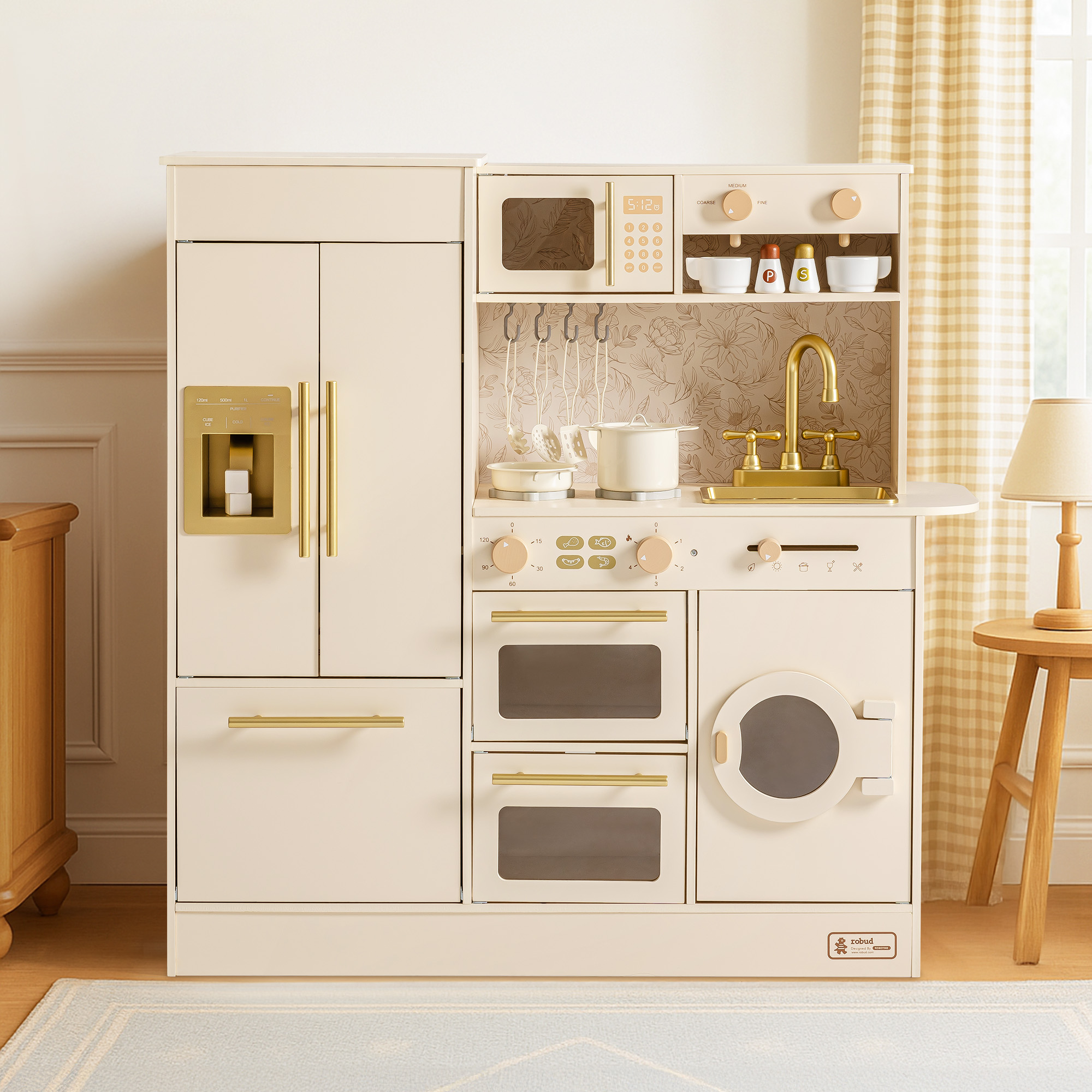
- Practical Knowledge: Children learn about cooking tools and utensils. They know that a pot is for boiling or that a refrigerator keeps food cold, connecting play to the real world. The Robud Mocha Montessori Wooden Play Kitchen, for example, includes a pretend dispenser, ice maker, and sink. Its realistic features (like a working faucet and a clickable stove knob) help kids mimic real tasks.
- Problem-Solving: If pretend pancakes burn on one burner, a child might decide to turn on the other burner to finish breakfast. This kind of planning and troubleshooting builds logical thinking.
An easy way to see this in action is to try a step-by-step pretend meal:
- Shopping and Prep: The child uses toy utensils and play food to plan a meal. Maybe they slice fruit or set a table, practicing fine motor skills.
- Cooking Sequence: Next, they follow a recipe in mini-steps and turn on the stove (knob clicks), stir in a pot, or place play dishes on the oven rack. Each action has an order.
- Problem-solving: If a play ingredient is missing, they decide on an alternative. They learn adaptability.
- Serving and Clean-Up: Finally, they might serve the meal to dolls or parents (role-playing guests) and wash up in the sink.
This little routine teaches cause-and-effect (stirring too much might spill the soup) and everyday life skills, all through play.
Social and Emotional Growth
The wooden play kitchen is also a social playground. When children cook together or invite others to join, they practice teamwork and communication. Role-playing family members or chefs and customers encourages conversation and empathy. For example, two kids playing with one kitchen might take turns being chef and server, this back-and-forth builds sharing skills and turns-taking.
Pretending kitchen play is more enjoyable if it's organized, because children naturally involve others and negotiate roles. They discuss "what is on the menu" and help each other prepare the feast. This social-emotional play is key, while baking a pretend unicorn pizza or tossing an imaginary salad, kids communicate with buddies or family members and learn to cooperate with others. They even practice handling disagreements ("Who gets to use the pan first?"). Over time, this helps them manage real emotions; for instance, if they pretend soup spills, they learn to stay calm and clean it up which is a form of emotional regulation.
In short, playing in a house or restaurant with a wooden kitchen builds social skills. It gives kids a chance to express feelings safely. As children pretend to serve a make-believe meal, they develop their language skills (chatting about recipes, ingredients, and roles) and self-confidence. By the time their feast is served, children often feel proud of what they've accomplished.
Fine Motor Skills & Physical Learning
Beyond mind games, a wooden play kitchen is a hands-on experience. Grasping a wooden spatula, turning knobs, opening cabinet doors, and picking up play fruits all fine-tune hand-eye coordination. These movements strengthen finger dexterity (think tying shoelaces later!) and teach precision.
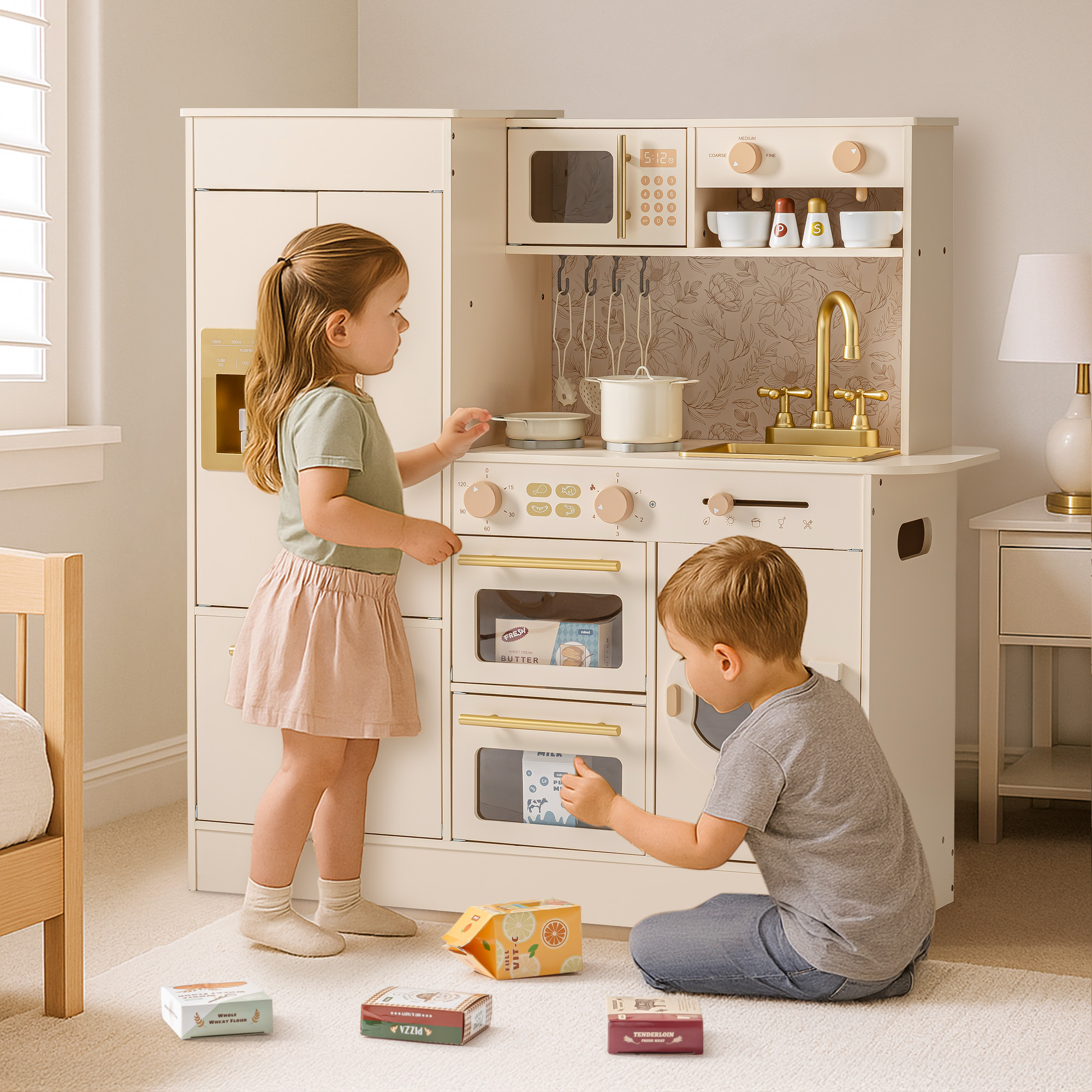
Every chop with a toy knife or stir with a spoon is quietly training young muscles. Even kneeling to reach the lower cabinet teaches gross motor skills (such as crawling under the sink to pretend it's broken). Physical activity, even small movements, boosts children's overall growth.
Interestingly, wooden kitchen play can also introduce simple science and health lessons. Children learn about the basics of healthy nutrition as they assemble pretend salads or sandwiches. Parents can even join in by adding real fruit for toddlers to mimic washing. These little lessons in real-life tasks are far richer than any tap on a screen.
Montessori Magic: Authentic Learning
The concept of a wooden play kitchen aligns perfectly with Montessori's ideas of real-life learning. In Montessori environments, toys are meant to be tools for independence, not just gadgets. A well-designed play kitchen such as the Robud Mocha Montessori Kitchen is highly functional and scaled for small hands. It encourages children to experiment with actual cooking and cleaning activities, just as Montessori philosophy suggests. For instance, some families place a Step stool in front of the kitchen so toddlers can safely reach the sink or pretend to fetch dishes, blending Reality with play.
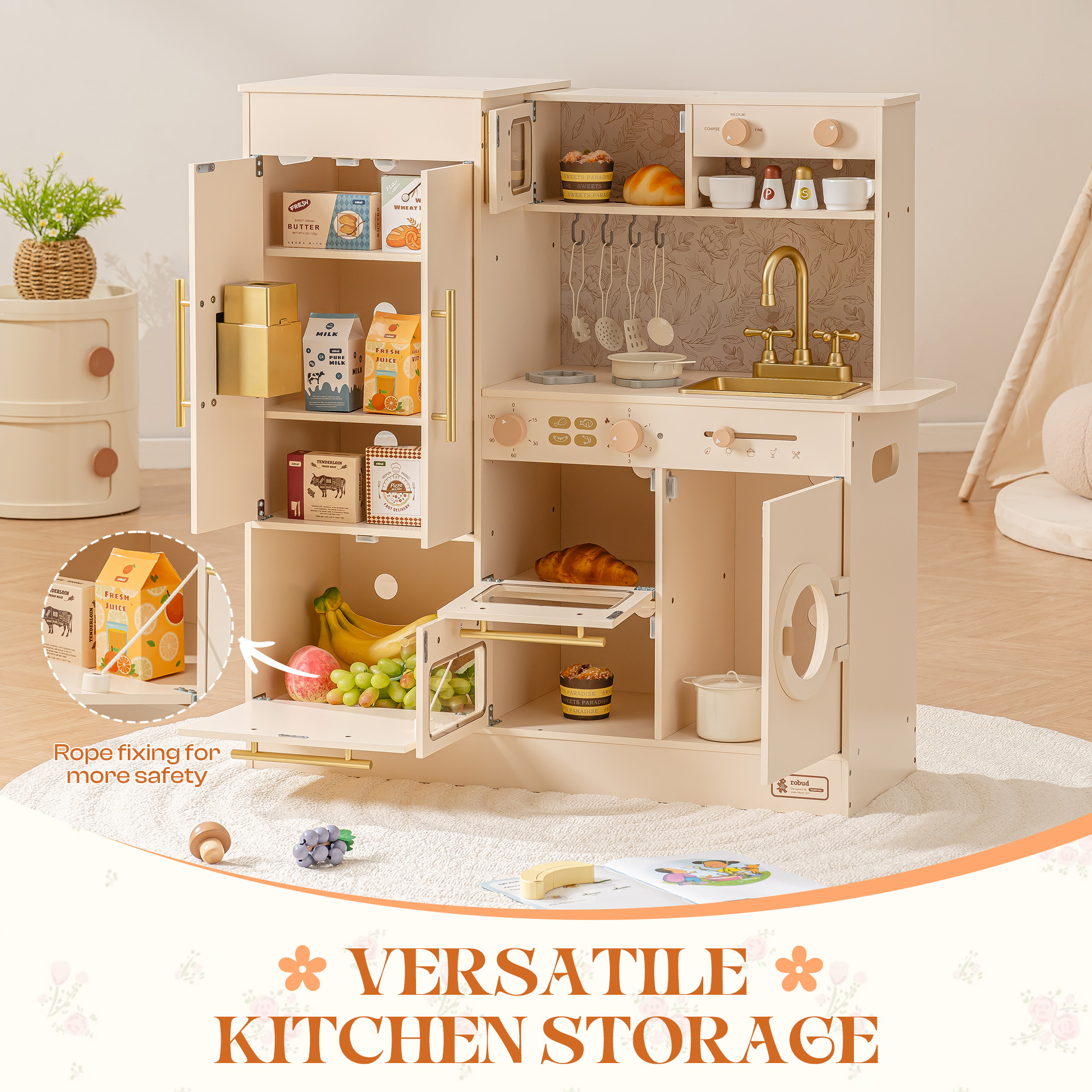
The natural materials of a wooden kitchen also fit Montessori ideals. Wooden utensils, cloth napkins, and play food made of wood or fabric evoke a sense of authenticity. Montessori moms note that kids learn to use functional devices and utensils correctly when they play with realistic setups. A toy kitchen arranged like a real kitchen (complete with towels, pretend dishes, and cleaning tools) teaches practical life skills: children might help parents by fetching play dishes or wiping spills, learning responsibility. This style of play is inherently self-directed: kids decide their menu, set their own pace, and learn through hands-on experiences.
By mirroring a real kitchen in miniature, a wooden play kitchen offers a child-led learning experience. The process of play that is choosing ingredients, setting the table, and cleaning up is very Montessori-friendly. It lets children explore daily routines safely and gain confidence in managing tasks.
Wooden vs. Digital: The Screen-Free Advantage
What about those kitchen apps or video games that simulate cooking? They might look flashy, but apps can't replace real-life kitchen play. Digital games are often highly scripted or repetitive, and they lack the sensory feedback of touching and manipulating real objects. Studies have found that excessive digital play can even be linked to lower development in areas such as language and social skills. By contrast, wooden toys encourage focus and imagination without the distraction of noisy lights.
Wooden play kitchens are intentionally screen-free. They offer a calm alternative that encourages a healthier balance in playtime activities. No bells and whistles means children stay engaged with the moment. They concentrate on mixing, matching, and storytelling instead of being distracted by games. In essence, when a child pretends to stir the soup in a wooden pot, their brain is building connections; they aren't passively watching a cartoon or clicking.
Parents also tend to interact more when toys are simple and straightforward. A study highlights that caregivers are often more present and talkative during traditional play than when kids are fixated on screens. So a wooden kitchen can spark conversations: asking "What's for dinner?" or "Let's bake cookies together" becomes a shared activity. These interactions further boost language and social learning which benefits a solo app just can't match.
Durable, Safe, and Sustainable
Finally, let's talk about practical concerns. Wooden play kitchens are designed to withstand years of enthusiastic play. Unlike plastic or cheap toys that break, quality wooden sets (like those in Robud's collection of play kitchens) are sturdy and durable. They often use smooth, rounded edges and non-toxic finishes, making them safe for little ones. For example, the Robud Mocha kitchen is specifically noted for its rounded edges and durable build, giving parents peace of mind as kids explore.
Wooden toys also align with eco-friendly values. They're often made from renewable materials and lack the electronic waste of gadgets. Additionally, they can be passed down to younger siblings or even gifted, meaning the value endures. A well-made wooden kitchen can grow with your family, whereas an electronic toy might end up obsolete.
In terms of value, consider what you get: hours of open-ended, educational play that fosters independence, not to mention the toy's lifespan. When you weigh the learning outcomes which are counting, language, creativity, and coordination against the cost, many parents find that wooden kitchens are a wise investment in child development.
|
Developmental Area |
Wooden Play Kitchen |
App-Based Toys |
|
Creativity and Imagination |
Encourages open-ended play and imaginative scenarios. Unlimited possibilities for role-playing and creativity. |
Often follows a set storyline, limiting creative freedom. |
|
Social Interaction |
Promotes face-to-face communication, teamwork, sharing, and taking turns with others. |
Often isolating; communication typically happens through the screen or through limited multiplayer features. |
|
Physical and Sensory Development
|
Engages tactile senses (touching wood, manipulating utensils) and promotes fine motor skills and hand-eye coordination. |
Limited to visual and auditory stimuli, lacking tactile or physical interaction. |
|
Cognitive and Problem-Solving Skills |
Encourages trial-and-error problem solving and independent decision-making in a hands-on environment. |
Often follows a set structure with limited scope for decision-making or independent problem-solving. |
|
Emotional Development and Empathy
|
Role playing encourages empathy and understanding of others' emotions (e.g., pretending to cook for a sick person). |
Emotions are often abstract or simplified, lacking the depth of real-life emotional experiences. |
|
Learning Through Trial and Error
|
Children experiment freely with cooking, discovering mistakes and solutions organically. |
Apps often offer controlled challenges, guiding children through tasks with less freedom for spontaneous learning. |
|
Physical Activity |
Encourages movement, such as walking around the kitchen, grabbing ingredients, or serving food. |
Typically sedentary, requiring only finger taps or swipes, with limited physical activity. |
Wrapping Up
A wooden play kitchen isn't just a toy; it's a learning tool wrapped in imagination. No app can teach a child how to truly feel a real bowl of pretend salad in their hands or how to negotiate roles with a sibling at the play sink. Through a toy kitchen, children practice independence, empathy, and real-world skills, all while having fun.
Whether it's the Robud Mocha Montessori Wooden Play Kitchen with Ice Dispenser or any other wooden kitchen set in the Robud collection, the magic comes from the hands-on experience. As your child sets the table for their stuffed animals or pretends to sip from a wooden mug, remember they're learning in ways an electronic toy simply can't teach. And that's the real recipe for growth and joy in play.
FAQ
What skills will my child learn from a toy kitchen?
Plenty. Imagination and creativity top the list, but children also pick up cognitive skills (like counting and sequencing) and language skills (naming foods and utensils). They practice fine motor skills (manipulating utensils and pretend food) and social-emotional skills (sharing, cooperating, and expressing feelings). In short, pretend cooking touches on math, science, art, and empathy all disguised as play.
How does a wooden play kitchen compare to a tablet app?
A kitchen toy engages all the senses and imagination in a way apps can't. Experts highlight that screen-free toys promote deeper focus and creativity, whereas digital play is sometimes linked to fewer language and social interactions. With an absolute toy, children actively engage instead of just watching, so they learn to solve problems and interact with others naturally.
Is it worth the cost?
Many parents find that the educational value, longevity, and joy a wooden kitchen provides make it worth the investment. Because it's sturdy and timeless, it can be used for years (and even passed on). When considering the multiple developmental benefits of a wooden kitchen which are cognitive, motor, social, and more, it often outweighs the cost of many single-purpose digital toys.
Коментирайте